
Termite Control
Termite Treatment in Chester County: Start at the Sill Plate
C.R. Davis III & Sons Pest Control inspects for and treats eastern subterranean termites in homes across Chester County, Montgomery County and Delaware County. We are licensed with the Pennsylvania Department of Agriculture in the Wood Destroying Pests category. Every job starts at the basement sill plates and joists, where Penn State Extension says most Pennsylvania infestations are found.
Eastern subterranean termites live in the soil under your house
The termite in southeast Pennsylvania is the eastern subterranean termite. Penn State Extension says it is present throughout the state. Colonies live in the ground and feed on cellulose: old roots, stumps, fallen limbs and, when they find a way in, the structural wood of a house.
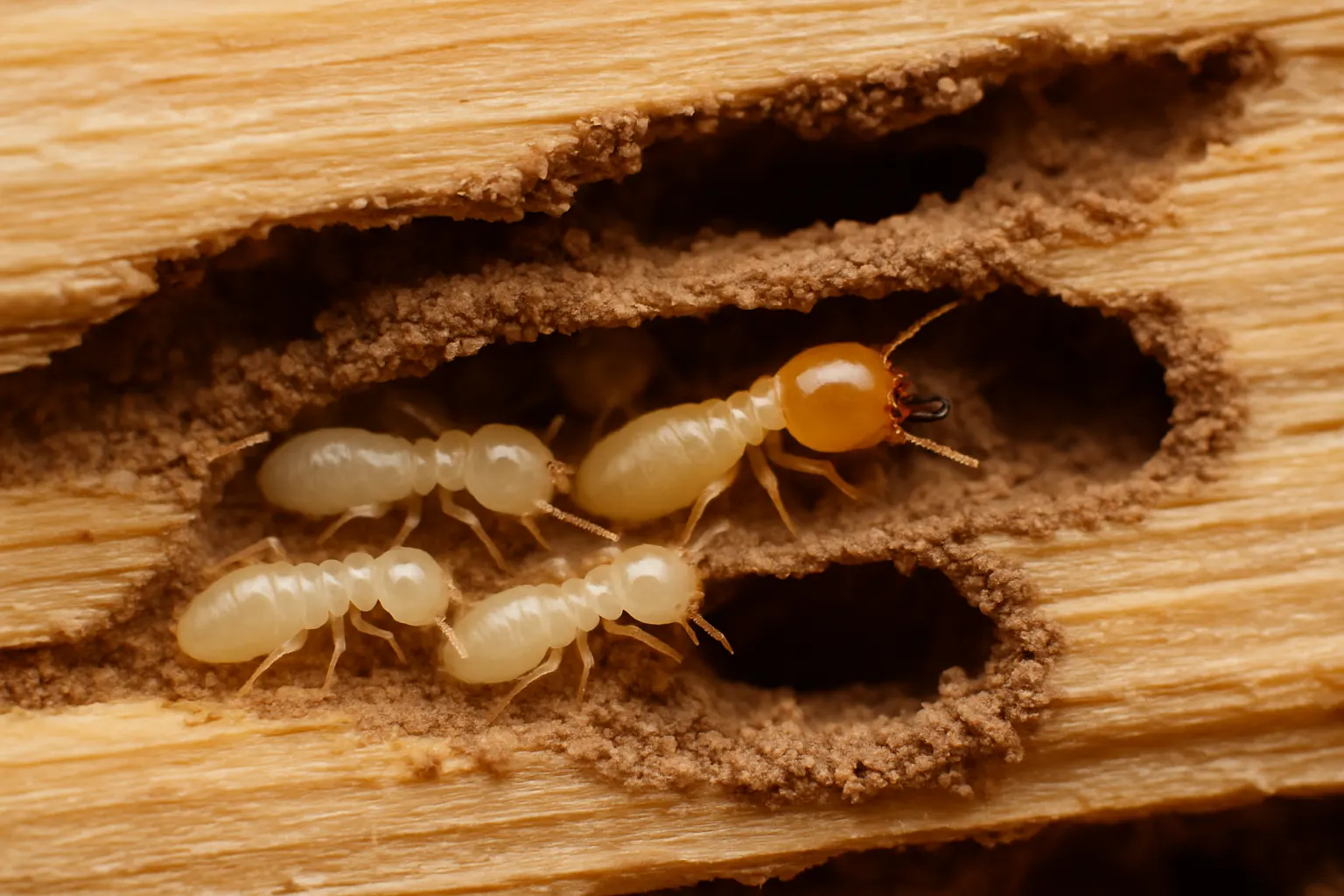
A colony has three castes. Creamy white workers, about a quarter inch long, do the feeding and the damage, and you rarely see them unless you break open a tube or infested board. Soldiers have long yellowish heads and large jaws and guard any breach. The kings and queens are dark brown to black, 3/8 to 1/2 inch long, with two pairs of equal-length wings.
Termite damage is slow. Penn State notes that by the time damage is visible, it is usually the result of years of feeding, and problems generally start 10 or more years after a house is built. That is no reason to wait, but it does mean you have time to get a proper inspection before deciding anything.
Swarm season runs February to June
In Pennsylvania, swarms of winged termites usually emerge between February and June, according to Penn State Extension. Swarmers are attracted to light, so indoors they gather at doors and windows, flutter for a short time, drop their wings and try to pair off. They do not damage anything themselves, but a swarm or a pile of shed wings inside is a sure sign that termites are working in the building.
Winged ants swarm in spring too, and people mix them up. The quick checks are below. If you are not sure, save a few in a sealed bag and we will identify them.
- Waist: an ant is pinched in at the middle, a termite is broad and straight.
- Antennae: ant antennae bend at an elbow, termite antennae are straight.
- Wings: termite wings are all the same length and nearly twice as long as the body. Ant front wings are longer than the back wings.
- Carpenter ants are the one common ant that damages wood. See our carpenter ant treatment page for how those differ.
Mud tubes, sill plates and joists: where we look
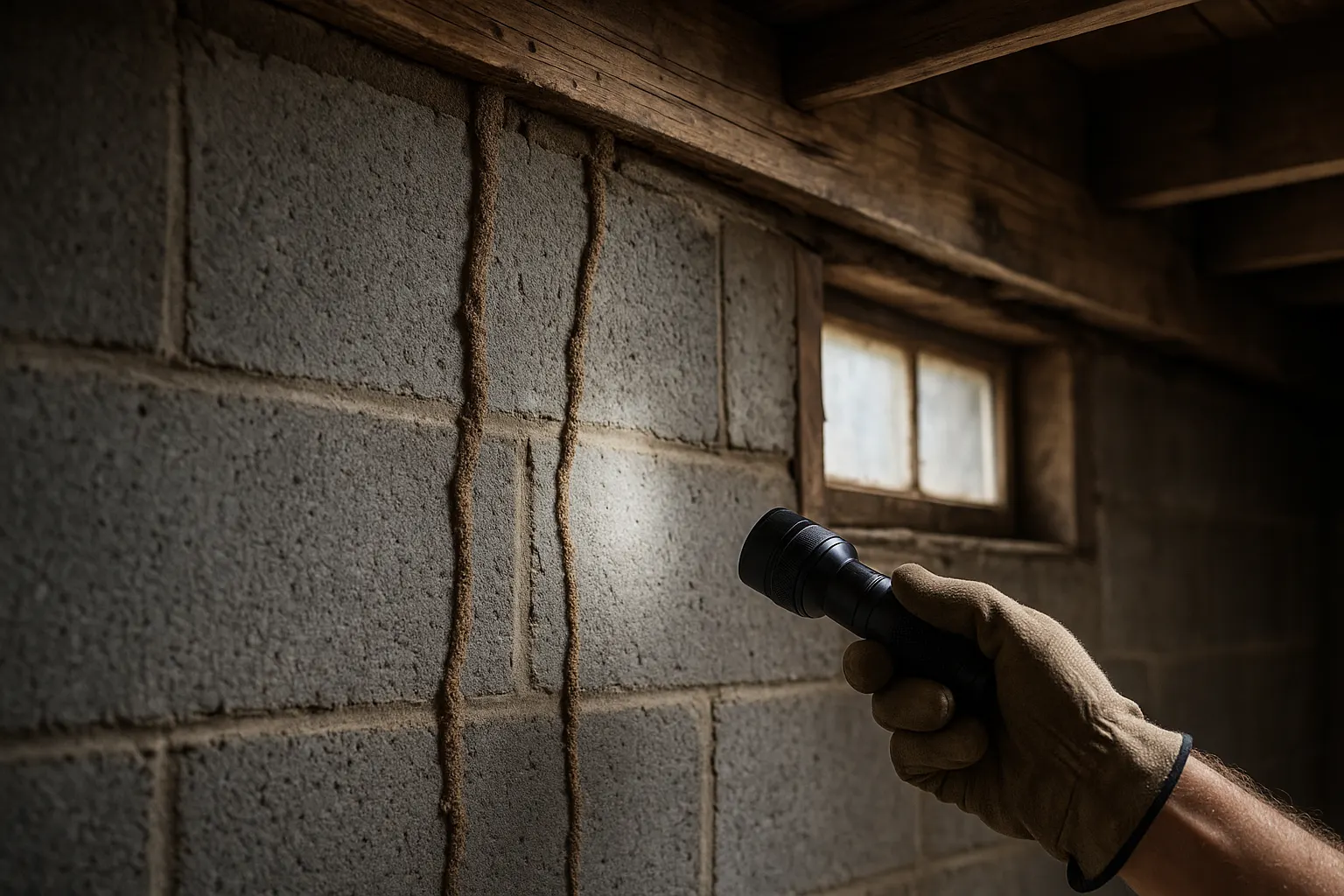
Subterranean termites need moisture and protection from open air, so they build earth-colored mud tubes from the soil to the wood they are eating. Look for them on basement and cellar walls, wooden posts, wall studs, mudsills, and door and window trim.
Penn State Extension reports that most Pennsylvania infestations are in the basement or cellar and in the framing just above the foundation wall: the sill plates, studs, joists, subflooring and floors. Wooden posts, steps and door frames set into a dirt or concrete floor are especially at risk. Termites also favor warm spots near furnaces, chimneys, water heaters and hot water pipes in winter.
Wood that termites have worked has galleries lined with a soil-like material glued to the wood. When we probe it with an awl or screwdriver, it gives, and workers may spill out. Carpenter ant galleries, by contrast, are smooth and clean.
Conducive conditions we name on every inspection
If those conditions stay, termites can reach the house again after treatment. These are the conditions Penn State recommends correcting, and they are the ones we look for in Chester County basements and yards:
- Wood in contact with soil: deck posts, porch steps, trellises, fence rails and old form boards left behind at the foundation.
- Firewood, lumber piles and stumps against or near the house.
- Wood less than 18 inches above the soil where it could be raised or replaced with pressure-treated material.
- Gutters and downspouts that dump water at the foundation, and soil graded toward the house.
- Cracks and voids in the foundation, including mortar gaps in fieldstone walls.
- Damp basements and crawlspaces without drainage or ventilation.
Liquid barrier and bait approaches
There are two main ways to treat subterranean termites, and Penn State notes that combining treatment with structural fixes gives the most satisfactory results.
A liquid soil barrier puts a labeled termiticide into the soil along the foundation so termites moving between the colony and the house pass through treated soil. Depending on the house, that can mean trenching along the outside foundation wall, injecting soil through a rod, or drilling through a slab, porch or patio to reach the soil beneath. Placement and rates follow the product label.
A bait approach sets stations with a cellulose material that termites feed on. The active ingredient is either in the bait from the start or added once feeding is confirmed, and workers carry it back to the colony. Penn State points out that baits are especially useful where a well or spring sits close to the foundation, where drain tile runs around the footing, or where a high water table makes soil treatment a poor fit.
Which one fits depends on the foundation type, water near the house, finished basements, additions and what the inspection finds. We explain the choice and the follow-up schedule before any work, and we tell you about re-entry for any treated interior area, per the label.
How a termite job runs: The Davis Inspection Standard
Termite work follows the same four steps as everything else we do. You can read the full version on how we inspect and treat.
- Identify the insect first. Swarmers, wings or a damaged board get confirmed as termites, not carpenter ants or powderpost beetles, before anything is applied.
- Find and name the conducive conditions, from wood-to-soil contact to the downspout draining at the corner.
- Place treatment where the termites are working and along the routes they use, per the label.
- Set the follow-up and tell you re-entry and prep instructions up front.
Older housing stock in our service area
House age by itself does not mean termites. But older homes have had decades for the conditions Penn State describes to build up: posts set in dirt cellar floors, porch additions on fill, stone foundations with open mortar joints and wood steps on bare soil. These boroughs and townships have some of the oldest housing in the area we serve, based on Census ACS 2020 to 2024 estimates.
| Town | County | Median year built | Homes built before 1940 |
|---|---|---|---|
| Borough of West Chester | Chester County | 1954 | 42.6% |
| Pottstown Borough | Montgomery County | 1951 | 38.9% |
| City of Coatesville | Chester County | 1952 | 37.4% |
| Norristown Borough | Montgomery County | 1957 | 32.9% |
| Kennett Square Borough | Chester County | 1957 | 28.7% |
| Media Borough | Delaware County | 1959 | 27.7% |
| Phoenixville Borough | Chester County | 1974 | 26.6% |
| North Coventry Township | Chester County | 1970 | 24.0% |
| Downingtown Borough | Chester County | 1968 | 21.3% |
| Easttown Township | Chester County | 1968 | 15.5% |
Powderpost beetles and other wood-destroying insects
Not every hole in old wood is termites. Powderpost beetles are small brown beetles, usually under a quarter inch, that breed in seasoned hardwoods, especially oak sapwood. The sign is a scatter of round exit holes about 1/16 to 1/8 inch across with fine, flour-like powder below them in flooring, paneling, beams, antiques and stored lumber.
Adults lay eggs in the pores and old exit holes of bare wood, usually in spring, and larvae feed inside for months before emerging. Because they can reinfest the same piece for generations, fresh powder and new holes matter more than old damage. Penn State notes that barns and sheds are often infested, which is worth knowing in a county full of old bank barns and outbuildings. Sanded and varnished wood is not normally attacked, and borate surface treatments can stop newly hatched larvae from entering unfinished wood.
Carpenter ants and carpenter bees also damage wood here. If you are seeing large black ants or round holes in fascia boards, our carpenter bee control and carpenter ant pages explain what to look for.
Buying or selling a house
Termite questions come up most often during a sale. Lenders often ask for a wood-destroying insect report, and Pennsylvania's seller disclosure covers termites and wood-destroying insects. That inspection is a different job with its own form and limits, described on our page for real estate termite (WDI) inspections.
C.R. Davis III & Sons is a family owned Pennsylvania corporation since 2003, based at 153 Silver Springs Rd in Phoenixville and insured. To schedule a termite inspection, call (610) 935-9130 or send us your details.
Where we provide termite control service
We work from our family business in Phoenixville and serve homes and businesses across Chester County, Montgomery County and Delaware County. See our Phoenixville pest control page or pest control in West Chester for the towns each area covers.
Sources
- Penn State Extension: Eastern Subterranean Termites
- Penn State Extension: Powderpost Beetles
- Penn State Extension: Carpenter Ants
- 7 Pa. Code § 128.42: Commercial applicator categories
- 68 Pa.C.S. § 7304: Seller property disclosure statement
- HUD: Form NPMA-33 Wood Destroying Insect Inspection Report
- U.S. Census Bureau ACS 2020 to 2024 5-year estimates (B25035, B25034) via Census Reporter
- National Pesticide Information Center
Termite Control: common questions
What month are termites most active in Pennsylvania?
Swarms are the most visible activity, and in Pennsylvania they usually happen between February and June, often on a warm day after rain. Worker termites feed through much of the year. In winter they tend to concentrate near warm spots such as furnaces, chimneys, water heaters and hot water pipes, according to Penn State Extension.
How do I tell if I have termites or carpenter ants?
Look at the insect and the wood. Termite swarmers have straight antennae, a broad waist and four equal wings, while ants have elbowed antennae and a pinched waist. Termite galleries are lined with soil and there are mud tubes. Carpenter ant galleries are smooth and clean, with piles of coarse wood shavings pushed out nearby.
Can you live in a house while treating for termites?
Yes, in most cases. Eastern subterranean termite work in southeast Pennsylvania is soil treatment or baiting, not tenting the house. Any interior drilling or treated area comes with re-entry directions from the product label, and we tell you those before we start, including how long to keep people and pets off treated surfaces.
How long until termites destroy a house?
Termites do not bring a house down in a few days. Penn State Extension says visible damage is usually the result of years of feeding, and problems typically start 10 or more years after construction. Damage still adds up, especially in sill plates and joists, so it is worth an inspection as soon as you see tubes or swarmers.
Can I do my own termite inspection?
You can look for the obvious signs: mud tubes on foundation walls, shed wings on windowsills, and wood that gives when you push a screwdriver into it. Penn State Extension still recommends a professional inspection, because a trained inspector knows where tubes hide behind stored boxes, insulation and finished walls, and can tell termites from other wood-destroying insects.
Can you ever fully get rid of termites?
The colony lives in the soil, often well beyond the house, so the goal is to stop termites from reaching and feeding on the structure. That means treatment placed where they travel, fixing moisture and wood-to-soil contact, and follow-up inspections. We explain the plan and the follow-up schedule for your house rather than making promises about the colony.
Will termites go away on their own?
No. Once a colony has a food source in your framing and a protected path to it, there is no reason for it to leave. Swarmers dying at the windows does not mean the colony is gone. Shed wings indoors are a sign the colony is active inside the building.
Should I get a termite inspection when buying a home?
It is a good idea in southeast Pennsylvania, where eastern subterranean termites are present statewide and much of the housing is decades old. Many lenders ask for a wood-destroying insect report anyway. The report covers visible evidence in accessible areas on the day of the inspection, so read the section listing obstructed areas carefully.
How do you tell if termites are behind drywall?
Signs include mud tubes coming out of a baseboard gap or wall crack, swarmers or wings near a window or light, and trim or baseboards that sound hollow or give when pressed. None of these confirm termites on their own, so we probe and inspect the framing below from the basement where possible.
Family owned. Licensed and insured in Pennsylvania.
Schedule an inspection for termite control
Tell us what you are seeing and where. We will call you back to set up a visit, identify the pest and walk you through the plan before any treatment.
- The species identified before anything is applied
- Entry points and moisture problems pointed out on your property
- Prep and re-entry instructions explained up front
Prefer to talk now? Call (610) 935-9130