
Rodent Control
Mouse and Rat Control in Chester County: Find the Runway, Then Set the Trap
C.R. Davis III & Sons Pest Control handles house mice and Norway rats in homes across Chester County, Montgomery County and Delaware County from our Phoenixville headquarters in East Pikeland Township, Chester County. We inspect first to find where rodents travel and nest, set snap traps and tamper-resistant bait stations along those routes, come back to check them, and show you the gaps they are using to get inside.

House mice and Norway rats are the two rodents we find in local homes
Almost every rodent call in southeastern Pennsylvania turns out to be one of two animals. The house mouse is small, 5 to 8 inches long counting the tail, with large ears and a habit of running along walls at night. The Norway rat is much bigger, 13 to 18 inches with the tail, with a blunt nose and a tail shorter than its body. Both numbers come from Penn State Extension.
Mice and rats live in different places, and that changes the job. Mice nest inside the house, in wall voids, behind appliances, under insulation and in stored boxes, and they seldom travel more than about 30 feet from that nest, according to UC IPM. Norway rats are burrowers. They usually live outside along foundations, under woodpiles and around sheds, and come into basements and ground floors to feed. A trap line that works for mice in a kitchen is the wrong setup for rats working a garage.
Mice move indoors from September to November
Mice live outdoors all summer in fields, hedgerows and the edges of wooded lots, which describes a lot of Chester County and Montgomery County. When nights turn cold in the fall, they follow warm air leaking out of houses and find the gaps it leaks through. That is why the first scratching in the ceiling tends to show up in October, not July.
Two native mice share that habitat. The Pennsylvania Game Commission says white-footed mice (Peromyscus leucopus) live in woods, fields, fencerows and stream margins and also turn up in farm buildings and houses, while deer mice (Peromyscus maniculatus) live in nearly every land habitat in the state. Both have white undersides, which helps tell them from a house mouse when one is caught in a garage or shed on a wooded Chester County lot.
A female house mouse can have 5 to 10 litters a year of about 5 or 6 pups, and the young can breed at 5 to 6 weeks old (UC IPM). A couple of mice that get in during October can become a real population by January if nobody does anything. Starting early in the fall is easier than starting after the holidays.
Stink bugs, lady beetles and camel crickets use the same fall gaps. If you are seeing them too, our page on stink bugs and other fall invaders covers what comes in with the cold.
Signs of mice and rats in the walls, attic or basement
Most people find droppings or chewed packaging well before they see a mouse or rat. Check these places with a flashlight: the back of the silverware drawer, under the kitchen sink, behind the stove and refrigerator, the top of the basement foundation wall, and around the water heater and furnace.
- Droppings. Mouse droppings are dark, pointed and about the size of a grain of rice. Rat droppings are blunt and about the size of a raisin.
- Grease marks. Dark, oily smudges along baseboards, sill plates, pipes and the edges of holes where rodents rub the same path every night.
- Gnaw marks. Chewed food packaging, wood trim, plastic and wire insulation. UC IPM notes rat tooth marks are larger, about 1/6 inch.
- Noises in walls and ceilings. Scratching and running at night, often in the ceiling above a kitchen or in the wall behind a range.
- Nests. Balls of shredded paper, fabric or insulation in drawers, boxes, wall voids and under appliances.
- Smell. A musky odor in closed cabinets or storage areas once numbers build up.
| Sign | House mouse | Norway rat |
|---|---|---|
| Droppings | Pointed, rice-grain size | Blunt, raisin size |
| Where it nests | Inside walls, cabinets, stored boxes | Burrows outside, basements and ground floors |
| Smallest gap | About 1/4 inch | About the size of a quarter |
| Trap behavior | Curious, investigates new objects | Wary of new objects for days or longer |
Twins and rowhouses from Phoenixville to Norristown and Pottstown
Housing age and shape change how a rodent job goes. In Norristown borough, 47.1% of homes are single-family attached units, twins and rows, and 55.4% were built before 1960, according to American Community Survey figures reported by Census Reporter. Pottstown borough is older still, with 69.2% of homes built before 1960. On the Chester County side, 39.8% of homes in Phoenixville Borough are single-family attached, and 42.6% of homes in the Borough of West Chester were built before 1940.
In an attached home, mice can move between units through shared basements, party walls, porch roofs and utility chases. Fieldstone and old brick foundations also have mortar gaps that a newer poured wall does not. None of that means your block has a problem. It does mean that in older attached homes we look at the shared wall and the neighbor's side of the basement, and we may suggest you talk with the neighbor. If you live in one of these towns, see our notes for Norristown homeowners and Pottstown homes.
How an inspection-led rodent visit works
Every job follows The Davis Inspection Standard. For rodents, that means four things in order.
First, we identify the animal. Droppings, gnaw marks and where the activity is tell us whether it is mice, rats, or something that is not a rodent at all. Second, we find and name the conditions that are helping them: gaps around pipes and wires, a gap under the garage door, pet food stored in open bags, firewood stacked against the house. Third, we place traps and bait where the rodents actually travel, following the label on anything we use. Fourth, we set the follow-up date before we leave and tell you what to expect in the meantime.
The inspection covers the kitchen, basement or crawl space, attached garage, utility entries and the outside of the foundation. When they are accessible, we also look at the attic and soffits.
Traps and tamper-resistant bait stations, and where each one fits
Indoors, trapping is usually the main tool. Mice run along walls, so traps go flat against the wall on the routes where droppings and grease marks are heaviest, behind appliances, along basement sill plates and inside cabinet bases. UC IPM suggests spacing mouse traps no more than about 10 feet apart where mice are active. Traps give you a count, and they leave nothing behind in a wall void.
Rats need a slower approach. Norway rats avoid new objects, sometimes for several days or longer, so traps may be baited and left unset until the rats are feeding from them, then set. Rushing that step teaches the rats to avoid the trap.
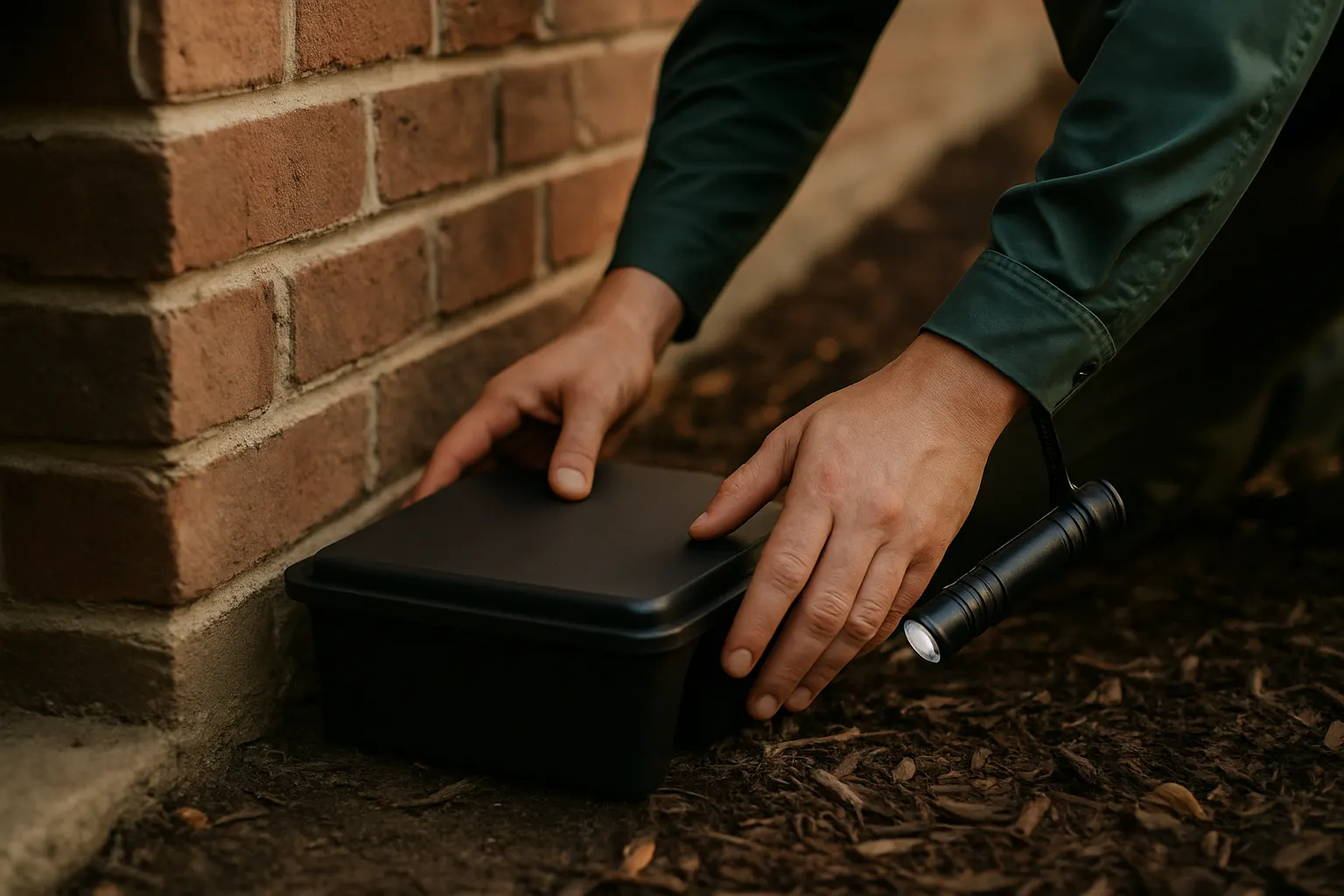
Rodenticide bait, when it fits the job, goes inside locked, tamper-resistant bait stations in places where children, pets and wildlife cannot reach the bait. Federal rules require that consumer rodenticide baits be solid blocks in secured stations, and we place stations according to the product label, most often outside along the foundation where rats and mice travel. We will tell you where each station is, what is in it, and what the label says about keeping people and pets away from it.
We show you where they are getting in
If the gaps stay open, new mice move in to replace the ones you trap. During the inspection we point out the gaps we find and explain what each one needs. You or your handyman can then seal them, and we can talk through the order that makes the most difference.
The common entry points in local homes are:
- Gaps where gas lines, water lines, AC lines and cable enter the house
- The sill plate on top of block or stone foundations, especially at corners
- Garage doors with a worn bottom seal and gaps at the side jambs
- Weep holes, dryer vents without a working flap, and open soffit ends
- Mortar gaps in fieldstone foundations and around basement windows
- Bulkhead doors and crawl space vents with missing screening
What to use when you seal a gap
Rodents chew through foam, plain caulk and wood. Penn State Extension recommends copper mesh, hardware cloth, silicone sealant and door sweeps, and UC IPM advises sealing openings larger than 1/4 inch with metal or concrete rather than anything gnawable. A good pattern is copper mesh packed into the gap, sealed over with a sealant or mortar that matches the surface.
Outside the house, cut back shrubs that touch the siding, keep firewood off the ground and away from the foundation, and store birdseed, grass seed and pet food in metal or heavy plastic bins with tight lids. Those steps make the traps work faster and cut down on what brings rodents back next fall.
Follow-up visits and ongoing protection
Rodent control takes more than one visit. We come back to check and reset traps, service bait stations, remove captures and look for new droppings. The number of visits depends on how many rodents there are, whether the entry points have been sealed and whether it is mice or rats. We tell you our plan at the first visit, and we adjust it based on what the traps show.
Homeowners who deal with mice every fall often roll rodent monitoring into a year-round home pest control plan, so the stations are checked before the cold arrives. If crickets and centipedes are showing up in the same basement, the camel cricket and centipede page covers those. To set up an inspection, contact our Phoenixville office or call (610) 935-9130.
Where we provide rodent control service
We work from our family business in Phoenixville and serve homes and businesses across Chester County, Montgomery County and Delaware County. See our Phoenixville pest control page or pest control in West Chester for the towns each area covers.
Sources
- Penn State Extension: Is There a Mouse in the House? Eliminate Mice with IPM
- Penn State Extension: Common Urban Pests, Identification, Prevention, and Control
- UC IPM Pest Notes: House Mouse
- UC IPM Pest Notes: Rats
- Census Reporter: Norristown, PA (ACS housing data)
- Census Reporter: Pottstown, PA (ACS housing data)
- CDC: How to Clean Up After Rodents
- Pennsylvania Game Commission: Mice and Voles
- U.S. Census Bureau, ACS 2020-2024 5-year, via Census Reporter
Rodent Control: common questions
How many mice do you have if you see one?
Seeing one mouse usually means there are more, because mice are active at night and stay hidden during the day. A female can have 5 to 10 litters a year. The droppings tell you more than the sighting. Fresh droppings in several rooms, or on more than one floor, point to an established group rather than a single visitor, and that changes how many traps we set.
Where do mice usually enter a house?
Mice usually get in through gaps where pipes, wires and AC lines pass through the wall, along the sill plate on top of the foundation, under worn garage door seals, and through vents without screens. A mouse can fit through an opening about 1/4 inch wide. In older stone and brick homes around Phoenixville, Norristown and Pottstown, mortar gaps in the foundation are also common.
When do mice come into houses in Pennsylvania?
Mice come into Pennsylvania houses mostly from September through November, when nights get cold and they look for warmth and food. Once inside, they stay through the winter because the house gives them everything they need. They do not leave on their own in spring, so a fall problem that nobody treats usually grows through January and February.
How long do mice stay in a house?
Mice will stay in a house indefinitely if they have food, water and a nest site. They do not move back outdoors when the weather warms. A house mouse seldom travels more than about 30 feet from its nest, so a group living in a kitchen wall can stay in that one area for generations until someone traps them and closes the gaps.
What keeps mice away?
Sealed entry points keep mice away better than anything else. Peppermint oil, ultrasonic plug-ins and dryer sheets are popular, but none of them closes the gap a mouse is using. Seal openings with copper mesh, hardware cloth, metal or mortar, fix garage door seals, and store food and birdseed in sealed bins. Then trap whatever is already inside.
Do you put poison inside my house?
We usually rely on traps inside living areas and place bait outdoors or in secured areas like garages and crawl spaces. When we do use rodenticide bait, it goes inside locked, tamper-resistant bait stations placed according to the product label. We tell you where every station is and how the label says to keep children and pets away from it.
How can I tell if I have mice or rats?
The droppings are the easiest way to tell mice from rats. Mouse droppings are pointed and about the size of a grain of rice. Rat droppings are blunt and about the size of a raisin. Rats also leave larger gnaw marks, and Norway rats often have burrows along the foundation, under woodpiles or beneath sheds outside.
Why aren't my mouse traps catching anything?
Traps usually fail because they are in the wrong spot or set the wrong way. Mice run along walls, so a trap in the middle of the floor gets ignored. Put traps flat against the wall where the droppings are heaviest, with the trigger end toward the wall, about 10 feet apart. If it is rats, they may avoid a new trap for days.
Do you do rodent control in Chester County and Montgomery County?
Yes. We serve homes in Chester County, including Phoenixville, West Chester, Downingtown and Kennett Square, and in Montgomery County, including Norristown, King of Prussia, Collegeville and Pottstown, along with Delaware County. Our office is in Phoenixville. See the Chester County service area page and the Montgomery County page for the towns we cover, or call (610) 935-9130 to set up an inspection.
How do I clean up mouse droppings?
The CDC says not to sweep or vacuum rodent droppings, urine or nesting material, because that can put virus particles into the air. Open doors and windows for 30 minutes first, put on rubber or plastic gloves, and spray the droppings until very wet with a disinfectant or a mix of 1 part bleach to 9 parts water. Let it soak for 5 minutes or as the label directs, then wipe it up with paper towels.
Related pest control services
Family owned. Licensed and insured in Pennsylvania.
Schedule an inspection for rodent control
Tell us what you are seeing and where. We will call you back to set up a visit, identify the pest and walk you through the plan before any treatment.
- The species identified before anything is applied
- Entry points and moisture problems pointed out on your property
- Prep and re-entry instructions explained up front
Prefer to talk now? Call (610) 935-9130