
Stinging Insects
Wasp and Hornet Nest Removal in Chester County: Identify the Species, Then Treat the Nest
C.R. Davis III & Sons Pest Control treats paper wasp, bald-faced hornet, eastern yellow jacket and European hornet nests at homes and businesses across Chester County, Montgomery County and Delaware County. We name the species first, because a paper wasp nest under a porch ceiling and a yellow jacket colony inside a wall void need very different work.
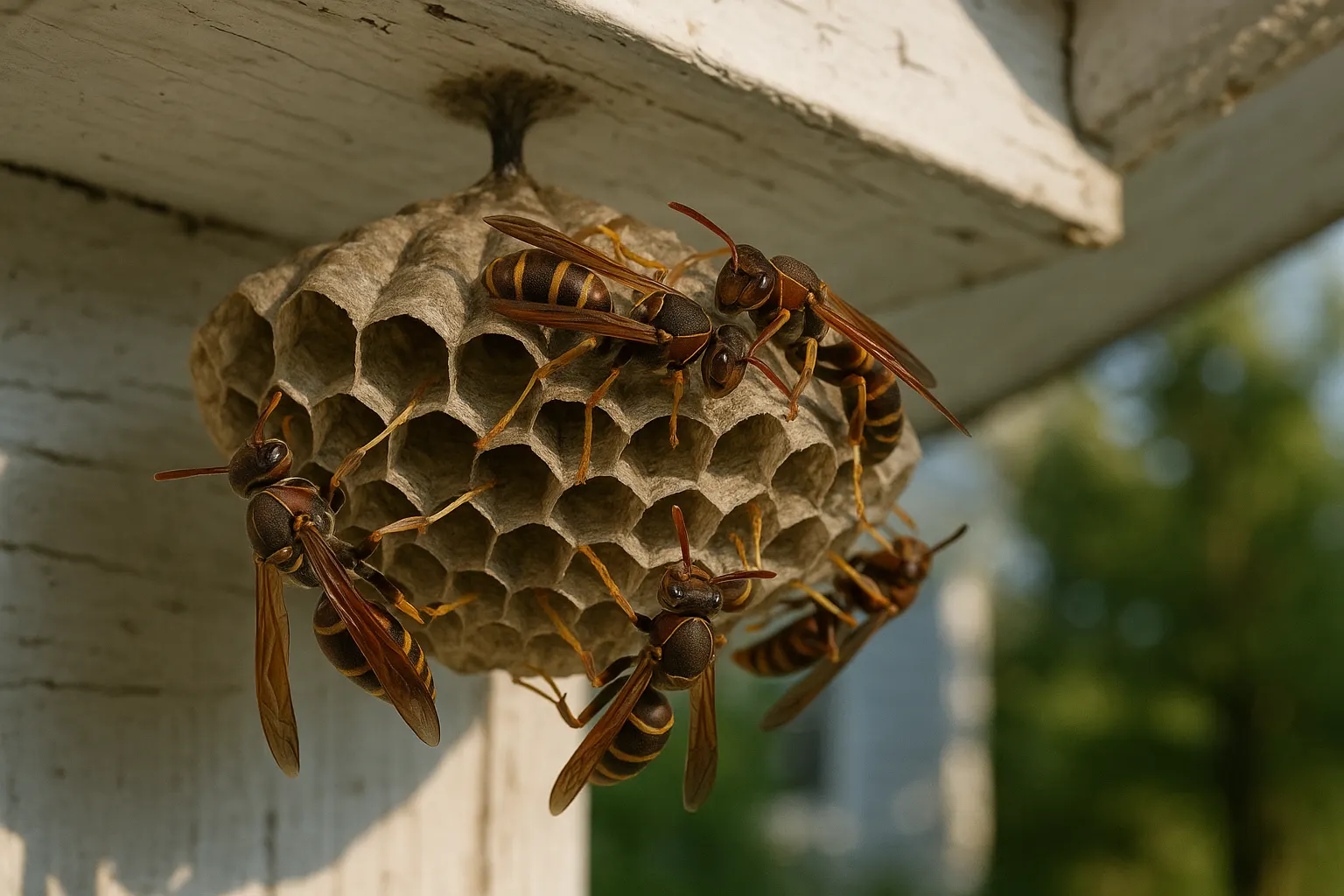
Four stinging insects cause most nest calls in southeastern Pennsylvania
Most people say "wasps" for anything yellow and black that stings. The species matters, because each one builds in a different place and defends its nest differently. These four account for most nest problems at homes in Chester County, Montgomery County and Delaware County.
- Paper wasps (Polistes species, including the native northern paper wasp and the European paper wasp). Open, umbrella-shaped combs with no paper cover, hung under eaves, porch ceilings, deck railings, grill lids and shutters. Colonies usually stay in the dozens, though Penn State notes some grow past 200.
- Bald-faced hornets (Dolichovespula maculata). Gray, football-shaped paper nests in shrubs, trees and sometimes on the side of a house. Penn State describes nests up to 24 inches tall in Pennsylvania, with a few hundred workers by late summer. They are technically aerial yellow jackets, not true hornets.
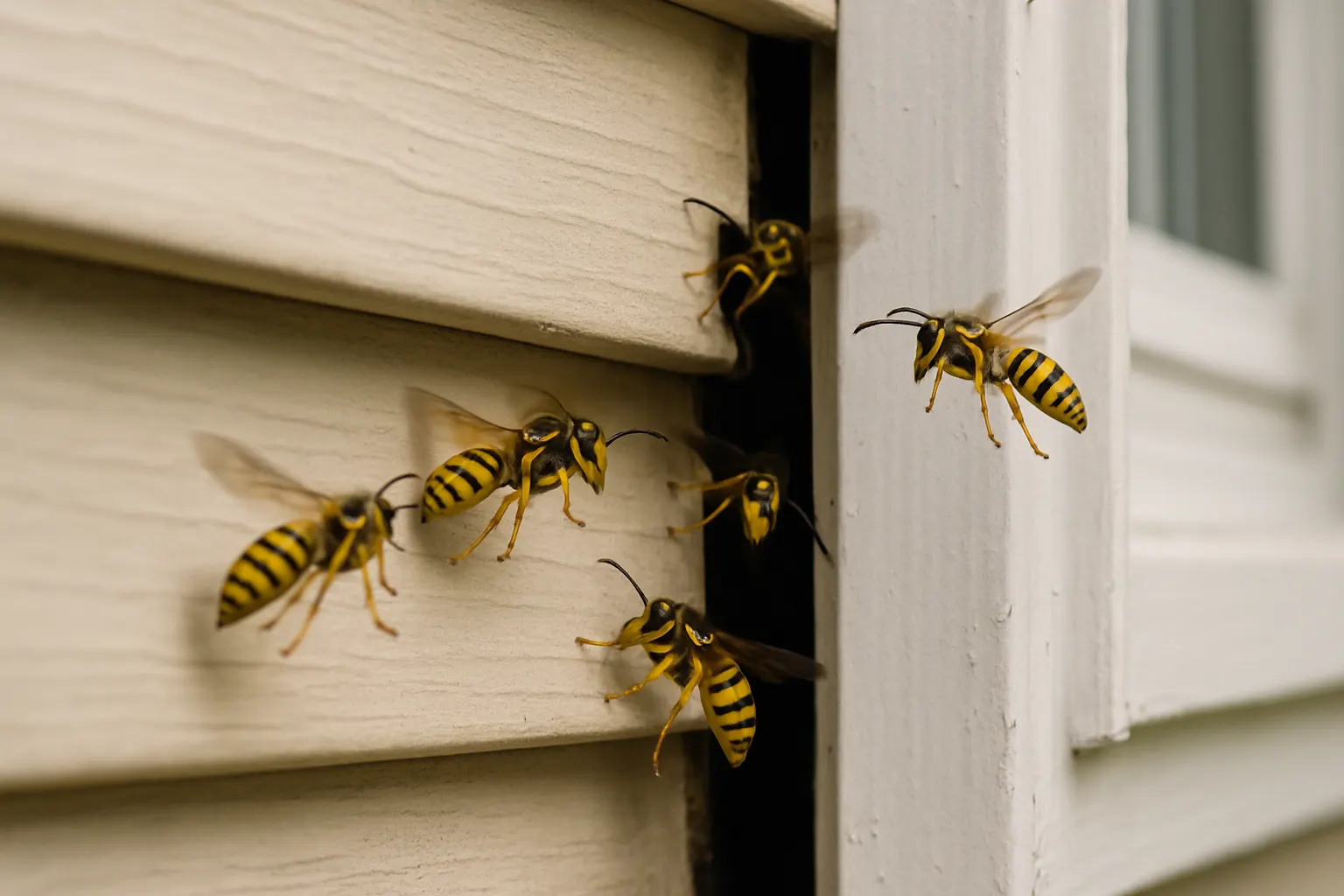
- Eastern yellow jackets (Vespula maculifrons). Mostly underground in lawns, garden beds, stone walls and creek banks, and sometimes inside a wall void or crawlspace. Colonies can reach into the thousands, and these are the insects that swarm soda cans and trash in late summer.
- European hornets (Vespa crabro). The large brown and yellow hornet that hits porch lights and windows after dark. Penn State calls it the only nocturnal wasp in the state. It nests in hollow trees, attics and wall voids, with 200 to 400 workers by the end of the season.
How the nest season runs from May to the first hard frost
Every paper wasp, hornet and yellow jacket colony here lasts one season. A fertilized queen spends the winter alone in a protected spot, often under loose bark or in a shed wall. In May she starts a small nest by herself and raises the first workers. Penn State Extension gives May as the month paper wasp queens establish nests, and May or June for eastern yellow jackets.
A nest the size of a golf ball in May is easy to miss. By August the same colony can fill a wall cavity or a hole the size of a basketball under the lawn. Penn State notes that wasps become more defensive later in the summer and into fall, when local food runs short. That is why most stings around decks, pools and gutters happen in August and September, and why a nest nobody noticed in June suddenly becomes a problem at a Labor Day cookout.
Workers and the old queen die off around the first hard frost. New queens leave to overwinter, and the old nest is not reused. A nest you find in November is almost always empty.
| Month | What the colony is doing |
|---|---|
| April | Queens come out of overwintering sites on warm days |
| May | Queens start new nests alone and raise the first workers |
| June to July | Worker numbers climb; nests grow quickly |
| August to September | Peak colony size and peak defensiveness; yellow jackets scavenge food and trash |
| October to November | Colonies decline and die off after hard frost; new queens seek shelter |
| December to March | Nests sit empty; the right time to seal old entrances |
Do not seal a wall-void nest entrance while the colony is active
The most common mistake we see is caulk or expanding foam pushed into the hole where yellow jackets or European hornets are going in and out of siding, a soffit gap or a weep hole in brick. It seems like the obvious fix, but it usually makes things worse.
Penn State Extension warns never to try to seal wasps inside a wall or the ground, because they can dig a new way out. A colony with a blocked entrance chews through whatever is softest. Behind vinyl siding and sheathing, that can be the drywall in a bedroom or the ceiling of a finished basement, and the wasps come out indoors.
If you see steady traffic in and out of one spot on the house, leave it open, keep people away from it and call us. We treat the colony through the entrance first. Once the nest is dead, we tell you when it is time to seal that gap, which is often best done over the winter.
Ground nests: yellow jackets in lawns, beds and stone walls
Ground-nesting yellow jackets use old rodent burrows, gaps under garden timbers, loose fieldstone walls and soft soil at the edge of a patio. The entrance is often no bigger than a quarter, and the colony below can be much larger than it looks. People usually find them by running a mower over the hole.
Pouring gasoline or boiling water into the hole, or stuffing it with a rock, tends to push the colony to open a second exit. Watch from a distance at midday to find the entrance, mark it with a flag from well back, and keep kids and pets out of that part of the yard until it has been treated.
Properties along wooded edges and creek banks see more of these nests. That includes a lot of homes around French Creek, the Perkiomen and the Brandywine, where lawns run straight into woods and old stone walls.
How C.R. Davis treats a wasp, hornet or yellow jacket nest
Every visit follows The Davis Inspection Standard, which starts with identifying the insect before anything is applied.
Identify the species and find the real entrance. A paper wasp comb, a bald-faced hornet nest in a holly and a yellow jacket colony in a wall void are three different jobs. We also look for second entrances on wall and ground nests.
Name what made the spot attractive. Open soffit returns, gaps where siding meets trim, a hollow porch column, a rotted fascia board, uncovered trash and fallen fruit all draw wasps. We point these out so they can be fixed after the season.
Place treatment in the nest itself, per the label. For exposed nests that means treating the comb or paper envelope. For ground and wall nests it means treating through the entrance into the colony. Treatment works best later in the day, when most foragers are back inside.
Tell you what happens next. Returning foragers may circle the entrance for a short time. We tell you how long to keep people and pets away from the treated area, per the label, when to remove an exposed nest and when to seal a wall or ground entrance.
Honey bees are pollinators: call us to identify them first
Honey bees (Apis mellifera) are not wasps. They are important pollinators, they are fuzzy and golden-brown rather than shiny yellow and black, and they build wax comb rather than paper. A single honey bee can sting only once.
If you have bees going in and out of a wall, or a cluster hanging from a branch or fence, call us to identify the insect before anyone sprays or seals anything. People often mistake yellow jackets for honey bees, and the reverse. Penn State warns that honey bees sealed into a wall can chew through drywall and come out inside the house.
A spring swarm, the football-sized cluster of bees resting on a limb, is a colony looking for a new home. Local beekeepers often collect swarms before the bees move into a wall or tree cavity.
Carpenter bees, cicada killers and other look-alikes
Large black and yellow bees hovering at the fascia or deck rail in April and May are usually carpenter bees, which drill round holes in bare wood rather than building a nest. See our page on carpenter bee holes in decks and trim for how that work differs.
Huge solitary wasps digging in sandy soil in July are often cicada killers. They rarely sting people and live alone rather than in a colony. Mud daubers build tube-shaped mud nests on garage walls and are rarely defensive. We identify these on site so you are not treating something that does not need it.
Cutting down on next year's nests
Colonies start from scratch every spring, so what you do in the off season matters. Penn State recommends making repairs over winter or early spring to block old colony entrances, once they are no longer active.
Seal gaps where siding meets trim, replace loose soffit vents and cap open porch columns. Keep trash and recycling bins closed, and pick up fallen fruit in late summer. Knock down small paper wasp starts in May, from a distance, before workers hatch. Homeowners on a year-round pest control plan can ask us to check eaves and deck undersides on spring visits.
- Walk the house in late May and look under eaves, railings and grill covers
- Mark any ground hole with steady traffic and keep the mower away from it
- Watch wall and soffit gaps for insects going in and out in July
- Seal old entrances between December and March, not during the season
Where we remove wasp and hornet nests
We work out of our headquarters on Silver Springs Road in East Pikeland Township, near Phoenixville, and serve homes and businesses across Chester County, Montgomery County and Delaware County, including West Chester, PA. Call (610) 935-9130 or send us a message and describe where the insects are going in and out.
Where we provide stinging insects service
We work from our family business in Phoenixville and serve homes and businesses across Chester County, Montgomery County and Delaware County. See our Phoenixville pest control page or pest control in West Chester for the towns each area covers.
Stinging Insects: common questions
Will a wasp nest eventually go away on its own?
Yes, by winter. Paper wasp, hornet and yellow jacket colonies in Pennsylvania die off around the first hard frost, and the nest is not reused. Before then, a nest near a door, deck or play area grows through summer and is most defensive in August and September, so waiting it out often means months of stings. Nests far from where people walk can often be left alone.
Do wasps get angry if you destroy their nest?
They defend it. Knocking down or spraying an active nest from close range puts workers in the air looking for the threat, and yellow jackets and bald-faced hornets will sting repeatedly. Ground and wall nests are the riskiest because you cannot see how big the colony is. Treating from a distance, late in the day, with protective gear, is why most people call a licensed company rather than doing it themselves.
Should I seal the hole where wasps are going into my wall?
No, not while the colony is active. Penn State Extension warns never to seal wasps inside a wall or the ground, because they dig a new exit, and that can be through drywall into the house. Leave the entrance open, keep people back, and have the colony treated. Seal the gap after the nest is dead, ideally over the winter.
What month are yellow jackets the worst in Pennsylvania?
August and September. Eastern yellow jacket queens start nests in May or June, colonies reach peak size in late summer, and Penn State notes wasps get more defensive as food resources shrink into fall. That is when yellow jackets crowd trash cans, drinks and picnic food, and when mowing over a ground nest causes the most stings.
How do I tell a yellow jacket from a honey bee?
Yellow jackets are shiny, bright yellow and black, and nearly hairless, with a narrow waist. Honey bees are fuzzy and golden-brown, with a thicker body, and they carry pollen on their legs. Yellow jackets build paper nests; honey bees build wax comb. If you are not sure what is going into a wall, call us to identify it before anything is sprayed or sealed.
What should I do about a honey bee swarm on a tree?
Leave it alone and keep your distance. A swarm is a queen and thousands of workers resting while scouts look for a new home, and swarming bees are usually not defensive. Local beekeepers often collect swarms. If bees have moved into a wall or soffit instead, call us to identify them first.
Why are there big hornets at my porch light at night?
Those are most likely European hornets. Penn State Extension describes them as the only nocturnal wasp in Pennsylvania, and they are drawn to lights and bump into lit windows. They nest in hollow trees, attics and wall voids. If you see them around the house after dark in late summer, look for a colony entrance in a nearby tree or the siding during the day.
Are bald-faced hornet nests in trees dangerous?
It depends on where the tree is. Bald-faced hornets are calm away from the nest but defend it hard, with repeated stings. Penn State notes nests can often be ignored unless they are within about 10 feet of a building entrance. A nest over a driveway, walkway, deck or play set is worth treating. One high in a tree at the back of the lot usually is not.
Can I just knock down a small paper wasp nest myself?
A small starter nest in May, with only the queen or a few wasps on it, is manageable for many homeowners from a distance. By midsummer, a comb with dozens of paper wasps under a porch ceiling or railing is a different job. Anyone allergic to stings should not try it. Nests in walls, soffits or the ground are best left to a licensed applicator.
Related pest control services
Family owned. Licensed and insured in Pennsylvania.
Schedule an inspection for stinging insects
Tell us what you are seeing and where. We will call you back to set up a visit, identify the pest and walk you through the plan before any treatment.
- The species identified before anything is applied
- Entry points and moisture problems pointed out on your property
- Prep and re-entry instructions explained up front
Prefer to talk now? Call (610) 935-9130